Why Data Engineering Matters More Than Ever
Introduction
We've all heard—and experienced—how critical data has become for modern organizations. At the same time, advances in AI and machine learning are reshaping nearly every aspect of how we live and work. Today, companies generate massive volumes of data across customers, products, sales, distribution, marketing, and digital interactions. This data underpins everything from long-term strategy to real-time operational decisions.
However, an important question is often overlooked: how does raw, fragmented data become reliable, structured, and decision-ready? This transformation is neither trivial nor automatic—and it rarely receives attention outside technical circles. This is where data engineering becomes essential.
Data engineering operates largely behind the scenes, which is why its impact is often underappreciated. At its core, it focuses on building scalable data pipelines that ingest data from diverse sources—such as transactional databases, APIs, and event streams—and consolidate it into centralized storage platforms like cloud-based data lakes and data warehouses.
More importantly, data engineering enables the automation of end-to-end data workflows, including extraction, ingestion, transformation, and validation. These processes standardize raw data, enforce schema consistency, and ensure high data quality. The result is a set of well-structured, analytics-ready datasets that power business intelligence, reporting, and machine learning.
In essence, data engineering transforms raw data into a trusted asset—one that organizations can confidently use to drive informed, data-driven decisions.
What is Data Engineering?
Data engineering is the discipline focused on designing, building, and maintaining scalable data systems that support the entire data lifecycle. Its goal is not just to make data available, but to ensure it is reliable, consistent, and optimized for downstream consumption.
In practice, data engineering involves building pipelines that ingest data from heterogeneous sources, store it in distributed systems, and transform it into structured, analytics-ready formats. These pipelines typically follow ETL or ELT paradigms and are orchestrated through workflow management systems to ensure reliability and fault tolerance. Modern architectures also emphasize schema evolution, data validation, and cost-efficient processing in cloud environments.
A modern data engineering architecture typically spans four interconnected layers — ingestion, storage, transformation, and serving — each playing a distinct role in the data lifecycle.
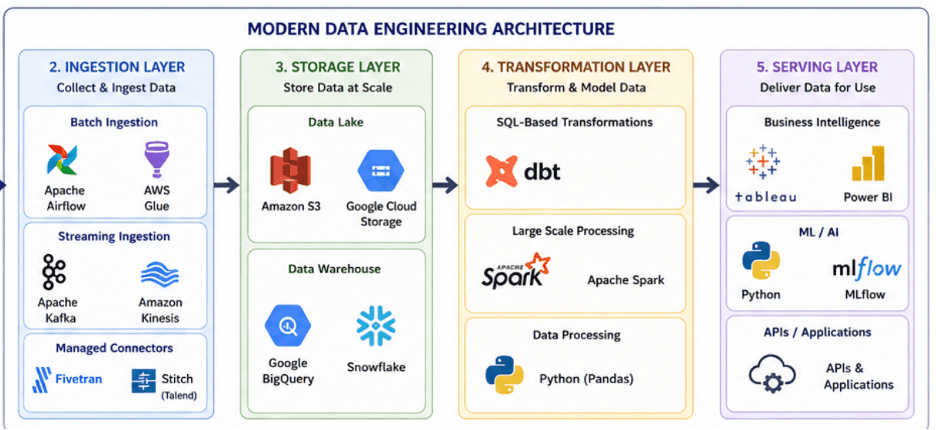 Modern Data Engineering Architecture — from ingestion through storage, transformation, and serving layers
The diagram above illustrates this end-to-end architecture:
- Ingestion Layer — Tools like Apache Airflow, AWS Glue, Apache Kafka, and Amazon Kinesis collect and ingest data through batch, streaming, and managed connector patterns.
- Storage Layer — Raw data lands in a data lake (Amazon S3, Google Cloud Storage) or is loaded directly into a data warehouse (Google BigQuery, Snowflake).
- Transformation Layer — dbt handles SQL-based transformations, Apache Spark processes large-scale datasets, and Python (Pandas) covers data processing needs.
- Serving Layer — Processed data is delivered to BI tools (Tableau, Power BI), ML platforms (Python, MLflow), and downstream APIs and applications.
To put this into context: data scientists build predictive models, and analysts generate insights—but both depend entirely on clean, well-structured data. Data engineers build and maintain the infrastructure that makes this possible. Without robust data engineering, even the most advanced machine learning models or BI dashboards fail to deliver meaningful results.
Why Data Engineering Matters
In most organizations, data is distributed across multiple systems—transactional databases, SaaS platforms, APIs, and legacy applications. This fragmentation is especially pronounced in large enterprises operating across multiple domains. Without a unifying layer, deriving meaningful, cross-functional insights becomes extremely difficult.
Data engineering solves this by integrating data from disparate sources into a centralized and consistent view. Well-designed architectures enable the ingestion of accurate, up-to-date data into cloud platforms such as data lakes and warehouses, balancing scalability, performance, and cost while ensuring low-latency access.
Manual data handling is neither scalable nor reliable. As data volume and complexity grow, manual processes quickly become inefficient and error-prone. Data engineering addresses this by automating pipelines for extraction, ingestion, and transformation. Orchestration tools like Apache Airflow or AutoSys are used to schedule, monitor, and manage these workflows, improving reliability and reducing operational overhead.
Modern organizations also require real-time or near real-time insights. Data engineering enables this through streaming architectures, allowing businesses to process and respond to events as they occur—whether it's customer activity, transactions, or system logs.
Another critical function is data transformation. Legacy systems often contain poorly structured schemas with unclear naming conventions that are not suitable for analytics. Data engineers clean, standardize, and model this data into well-defined formats that are easy for downstream teams to use. At the same time, they enforce data governance practices such as masking and access control to protect sensitive information.
Ultimately, the value of data depends on its quality. Poor-quality data leads to unreliable insights and flawed decisions. Data engineering ensures consistency, accuracy, and completeness—enabling organizations to trust their data and act on it with confidence.
Challenges of Data Engineering
As data systems scale, data engineering becomes increasingly complex. Handling large volumes of data while maintaining performance and scalability is a constant challenge. At the same time, ensuring data quality is difficult, as data from multiple sources is often inconsistent, incomplete, or continuously changing.
Integrating diverse data formats—structured, semi-structured, and unstructured—adds further complexity. Organizations must also balance batch and real-time processing, where real-time systems introduce additional challenges in latency, reliability, and cost.
Maintaining resilient pipelines is another critical concern, especially as upstream schema changes can disrupt downstream processes. In cloud environments, cost management becomes equally important, as inefficient queries and poorly designed pipelines can quickly drive up expenses. Alongside this, enforcing data security and governance is essential to protect sensitive data while keeping it accessible for analysis.
Ultimately, data engineering is not just about building pipelines—it is about ensuring they are scalable, reliable, secure, and adaptable to constant change.
Conclusion
Data engineering is not just a backend function—it is a foundational capability for modern data-driven organizations. While it often operates out of sight, its impact is visible in every dashboard, model, and business decision.
As organizations continue to invest in AI and advanced analytics, the importance of strong data engineering foundations will only grow. Without it, data remains raw and fragmented. With it, data becomes a strategic asset that drives innovation and competitive advantage.
Comments & Reactions
No sign-in needed — readers can like and comment directly.
No comments yet. Be the first to share your thoughts.